Showing posts with label Slavonian grebe. Show all posts

Monday, 7 March 2016

Surprise Scaup on Dartmoor and a Chilly Day on the Exe

A sunny but chilly afternoon on Friday 4th March and we decided to head out for a quick walk, choosing to go to Burrator Reservoir on  Dartmoor. It was a cold day and we braved the occasional sleet and hail shower but at least it was dry underfoot on the tarmac road surrounding the reservoir. The woodlands held the usual birds - siskin, robin, nuthatch, a buzzard, 2 jays, blue tits, great tits and coal tits, and a roe deer - and on the water were the usual wildfowl - a male and 2 female goosander, 2 cormorant, Canada geese, mallard, 4 Muscovy duck and a white farmyard goose. However a pair of ducks caught my eye just before they dived and I expected them to be tufted ducks but was very surprised when they resurfaced to see that they were actually scaup, my first Burrator sighting.

They were a little distant and were constantly diving and I checked out the male bird carefully as the regular overwintering male lesser scaup is still present and mobile around the reservoirs in Cornwall.

Nice birds to find and totally unexpected!

 Male Greater Scaup - cropped and zoomed record shot

Female Greater Scaup - another zoom and crop shot

Sunday 6th March and it was an early start to head off to the River Exe for my annual birding boat trip with my mate Mavis, postponed from January. It was clear and very cold when I met Mavis at Crownhill in Plymouth at 07:30 for the drive to Exmouth and it remained cold all day although it did cloud over at times. I wasn't sure what the birding would be like as we have never done such a late trip together in March before and despite the current cold snap it has been a fairly mild autumn and winter but I needn't have worried as it was an excellent trip as usual.

After a much needed cooked breakfast at the cafĂ© in Exmouth we boarded the boat and headed out to sea for a brief cruise around before heading upriver. The guide had seen the Bonapartes gull off Exmouth as we set off but couldn't refind it and despite looking out for it all along the trip it wasn't reseen. A distant diver species (probably great northern) was also seen flying over Dawlish Warren and into the estuary but we didn't find it again either. 

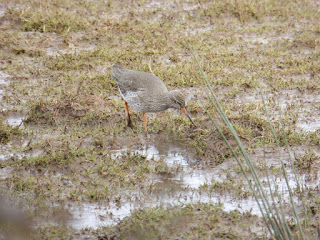
The lower reaches of the estuary were relatively quiet but things livened up as we arrived off Powderham Park where we saw a very nice spotted redshank feeding with a greenshank and redshanks along the shoreline, getting some excellent views. A Slavonian grebe popped up nearby before continuing to dive as it headed upriver. At Turf a large flock of dark bellied brent geese were resting on the mudflats and I finally managed to see my first black brant when the guide picked it out amongst the mass of birds - a very dark backed looking bird with bright white flank markings but it was walking away from the boat and only gave brief and obscured views of its large white neck collar but I was very pleased to see it after dipping it so many times. We had also seen 4 pale bellied brent geese amongst the dark bellied brent geese off Exmouth earlier so it was a three sub-species day for brent geese.

 Spotted Redshank

 Spotted Redshank (left) with Redshank

 Redshank (left) with Spotted Redshank

 Spotted Redshank

 Greenshank

Slavonian Grebe

Nearing Topsham and we had excellent views of bar- and black-tailed godwits with some of the black tails in summer plumage and some sporting coloured plastic leg rings. Avocets, knot, dunlin, grey plover, curlew, redshank and oystercatcher also gave good views along with another (or the same?) spotted redshank found off Topsham Quay and a flyover snipe from Exminster Marshes.

Teal, mallard, red breasted merganser (with the males busily displaying), great crested grebe (some in summer plumage), shag, cormorant and 2 female goldeneye flying upriver near Topsham were also seen.

Heading back downriver to Exmouth as the tide raced in and the common/harbour seal we had seen on the journey upriver hauled out on the sand banks had been joined by a grey seal - the harbour seal has been resident for a few years now and is thought to be visually impaired but it certainly wasn't keen on the inquisitiveness of the grey seal. A flock of 19 sanderling were feeding along the waters edge of the sand banks and turnstones were feeding along the pebbly shoreline bringing the wader species count for the cruise up to 14.

 Harbour (Common) Seal

 Harbour Seal with Exmouth in the Background

 Grey Seal

Harbour Seal (left) with Grey Seal

After the trip we stopped off at Bowling Green Marsh for a look around and had some good views of the waders coming in to roost at high tide - avocet, grey plover, dunlin, a knot, redshank, black - and bar-tailed godwits, curlew and lapwing (wader species 15 for the day) - and we had good views of at least 6 snipe feeding around the Marsh. Pintails, shovelers, teal, wigeon and a pair of tufted ducks were also seen feeding across the Marsh with a buzzard occasionally spooking the wigeon flock as it soared and mewed overhead before settling in the nearby trees. A pair of stock dove displaying and a water rail feeding out on the grass by the hedgerow were also good to see.

 Snipe, Bowling Green Marsh

Redshank, Bowling Green Marsh

We headed off to Darts Farm for a quick look in the fading light but it was very quiet with a flyover kestrel being new for the day but with the temperature dropping again we headed off back to Plymouth, having had an excellent if very cold days birding. 

Tuesday, 20 January 2015

Ferruginous Duck at Slimbridge and Bonaparte's Gull at Exmouth

Saturday 17th January and my first proper birding day of the year saw me heading off to Slimbridge on the Plymouth RSPB groups coach trip, a bargain at £26 for transport and entry to the reserve but the down side is not getting there until 12pm and only having 5 hours there. However I still had a great day out and saw some good birds on a sunny, cold and crisp day.

A female ferruginous duck (of unknown origin) has been showing in the Asia pen in the collection and so I headed there first to have a look but drew a blank. I checked out the nearby South Lake where it is also sometimes seen but again there was no sign of it and so I headed off to the Tack Piece which was well flooded and absolutely covered with birds. Scanning through the wildfowl and waders I managed to find at least 3 ruff, 2 little stint (my first ever overwintering birds), a pink footed goose amongst the white fronted goose flock, Bewicks swans, a snipe and 5 of the reintoduced common cranes.

Common Crane, Slimbridge

I headed back to the Asia pen and immediately found the ferruginous duck sleeping at the back of the pen amongst some Baers pochards, a close relative of it. But what is its provinence? I guess it is unlikely to be a wild bird, at best feral, at worst an escape. I think it should be International law that all wildfowl in collections should be ringed with a prominent coloured plastic leg ring to identify them as individuals from collections but then birds born in the wild from any escaped birds would not have these rings. However it is only my second UK sighting, having seen my first one back in February 1985 in Suffolk during a very cold snap.

 Ferruginous Duck

Ferruginous Duck

Also seen during my visit were a very confiding water rail, 8 brown rats scavenging under the bird feeders, fieldfares and redwings in the fields, 2 peregrines and an adult lesser black backed gull on what had been a very cold but very enjoyable day.

 Brown Rats

 First Snowdrops of the Year

 Water Rail

 Bewick's Swans

 Bewick's Swans

 Bewick's Swan TUZ - Bianco, ringed at Slimbridge in 2000

Bianco the Bewick's Swan 

The next day and an early start for a trip with Mavis and Mike to the River Exe for a birdwatching cruise from Exmouth to Topsham and back. It was cold and crisp and sunny again and after a delicious cooked breakfast in the Dockers cafe we headed off on the boat.   On leaving Exmouth we headed out to sea a short way before turning and sailing upriver and as we passed Exmouth Quay a female type black redstart was feeding amongst the rocks on the beach. However my attention was drawn to a small gull flying around and dipping down to the water and on checking it out I realised it was the elusive adult Bonaparte's gull! Bubble gum pink legs, short black bill, small size, large black splodge behind the eye and just a thin black edge to its underwing wing tips - result!

The rest of the trip wasn't quite as exciting but we did see some great birds and with some great views. Highlights were the long staying resident Slavonian grebe near the wreck, a male goldeneye flying downriver, around 400+ avocets, lots of red breasted mergansers, a spotted redshank with greenshank at the outlet of the River Kenn and the resident harbour seal hauled out on a sand bar in the river.

After the trip we stopped off on the way back to Plymouth at Bowling Green Marsh for a quick look. It is the first time I have visited the new revamped hide, very nice but the glass in the windows is optically rubbish, you have to open the flaps to view the birds with binoculars due to the distortion, not so great if the weather is cold and wet and windy. Bird highlights were a very showy but distant water rail, a distant chiffchaff in the hedgerow with blue and great tits, 2 flyover ravens, a lone snipe, a very orangey/red looking fox, a flyover stock dove and some lovely views of lapwings looking resplendent in the sunshine.

Lapwing, Bowling Green Marsh

A quick walk along the new cycle path at Goosemoor before heading back to Plymouth and a spotted redshank showed very well in the fading light as it fed with redshanks and a greenshank, a nice end to another very cold but enjoyable and productive day.

 Spotted Redshank (left) with Redshanks

Spotted Redshank (Centre)

Sunday, 29 June 2014

River Exe and Wembury

Saturday June 27th and I headed off to Topsham to have another look at the apparently summering Ross's gull, seeing the resident Slavonian grebe in summer plumage at Cockwood from the train on the way there. Arriving at the hide at Bowling Green Marsh at around 8:30 there were just 2 birders present so I settled in to scan the roosting birds present due to the high tide. The Ross's gull had been showing very well around 15 minutes before I arrived before disappearing amongst the large numbers of black headed gulls but eventually I managed a brief flight view of it as it landed on the mud before walking off behind a grassy bank and out of sight - not the views I had hoped for! It stayed hidden for a good hour before all the gulls took off together and flew off to the River Clyst. I again managed some brief flight views but I soon lost it amongst the flying gulls, again not the views I had hoped for! Never mind.

As compensation I had some distant views of 2 summer plumaged spotted redshanks roosting amongst the wader flock, mostly obscured by redshanks, curlews and black-tailed godwits but eventually showing well before flying off to the River Clyst as the tide receded. Also seen amongst the wader flock were 4 greenshanks, 2 whimbrel and a few lapwing.

2 (distant) Spotted Redshanks (on the left) with Redshanks

I headed off to Dawlish Warren for a wander around, getting wet at times in the heavy showers before sweltering in the sunny spells. Marsh helleborines were in flower and there were a few tatty looking southern marsh orchids still hanging on. Small skippers were very noticeable along with meadow browns and a few six spot burnets. I managed to find some cinnabar moth caterpillars and some mullein moth caterpillars and a few blue tailed damselflys were flitting about amongst the bramble bushes.

 Marsh Helleborine
 Marsh Helleborine
 Female Blue tailed Damselfy
 Male Blue tailed Damselfly
Mullein Moth Caterpillar

Offshore a few gannets were flying around with Sandwich terns diving for fish. A flock of around 10 common scoters were very hard to see amongst the choppy seas. On the main pond were 4 well grown young little grebes with 2 reed warblers heard singing. Chiffchaff and blackcap were heard and whitethroats were busily songflighting and a pair of Canada geese were very protective of 4 goslings, hissing at me as I passed by.

Sunday 29th June and I headed off to Wembury despite the grey skies but it eventually turned out quite sunny and warm. Bird wise it was as expected very quiet with 1 oystercatcher, 2 curlew and 7 male and 1 female mallard along the beach and a few gannets offshore. Chiffchaff and blackcap were heard and whitethroats were heard and seen including quite a few fledglings. Stonechat fledglings were also noticeable. A cirl bunting was heard singing near the sewage farm with a second bird seen singing at the same time and later a third male was seen at Wembury Point.

Insect life was again abundant with a large skipper, a red admiral, a large white and 2 small tortoiseshells being seen along with my first for the year small white and a marbled white. There were also good numbers of ringlets and meadow browns flitting around. Best of all was a hummingbird hawkmoth flying back and forth over a shale covered area on the cliff at Wembury Point, presumably enjoying the radiant heat, and 2 six spot burnets were seen feeding on thistle flowers. Bloody-nosed beetles were seen high up in the pathside vegetation including a mating pair and 2 young speckled bush crickets were also seen. It was also nice to see the sea kale has survived on the beach after the horrendous winter storms as it finally comes in to leaf.

 Ringlet
Marbled White
 Bloody-nosed Beetle
 Speckled Bush Cricket nymph
Sea Kale hanging on in there along the beach

Heading home and I stopped off at Blagdons Meadow to look for bee orchids but I was out of luck although there was a very tatty southern marsh orchid still hanging on. A lone burnet companion was seen along with six spot burnets, meadow browns and a ringlet. 2 male whitethroats were still singing away and a shelduck was feeding on the very smelly mudflats at low tide before I headed off home just as a shower of rain started.